What a season it turned out to be for the Vancouver Canucks.
Just a year prior, they had claimed the Pacific Division regular season title, defeated the Nashville Predators in the opening round of the playoffs, and engaged in a memorable seven-game series against the Edmonton Oilers.
Their head coach, Rick Tocchet, received the Jack Adams award, Quinn Hughes became the first defenseman in Canucks history to win the Norris Trophy, and goaltender Thatcher Demko was a Vezina Trophy finalist.
From an external perspective, the Canucks appeared to be on a positive trajectory. They seemed to have built a culture conducive to ongoing success, having come a significant distance from the team President of Hockey Operations Jim Rutherford inherited upon his arrival in 2021. The organization had made several smart acquisitions through free agency and trades, and draft picks were successfully graduating to the NHL level.
However, as all Canucks fans are now aware, underlying issues had already begun to surface by the previous off-season, ultimately leading to a challenging 2024-25 campaign where things consistently went awry.
Every NHL club conducts a thorough review of its operations during the off-season. It`s essential to identify what went wrong and what steps are needed to rectify lingering problems. It`s equally important to recognize areas of strength and develop strategies to maintain positive momentum.
Following the season Vancouver just experienced, there is considerable analysis required for the Canucks.
With that in mind, here is my attempt at providing an end-of-season review for the Canucks.
Roster Breakdown
The majority of Vancouver`s roster is slated to return next season, with just four players set to become unrestricted free agents.
Let`s examine the team position by position:
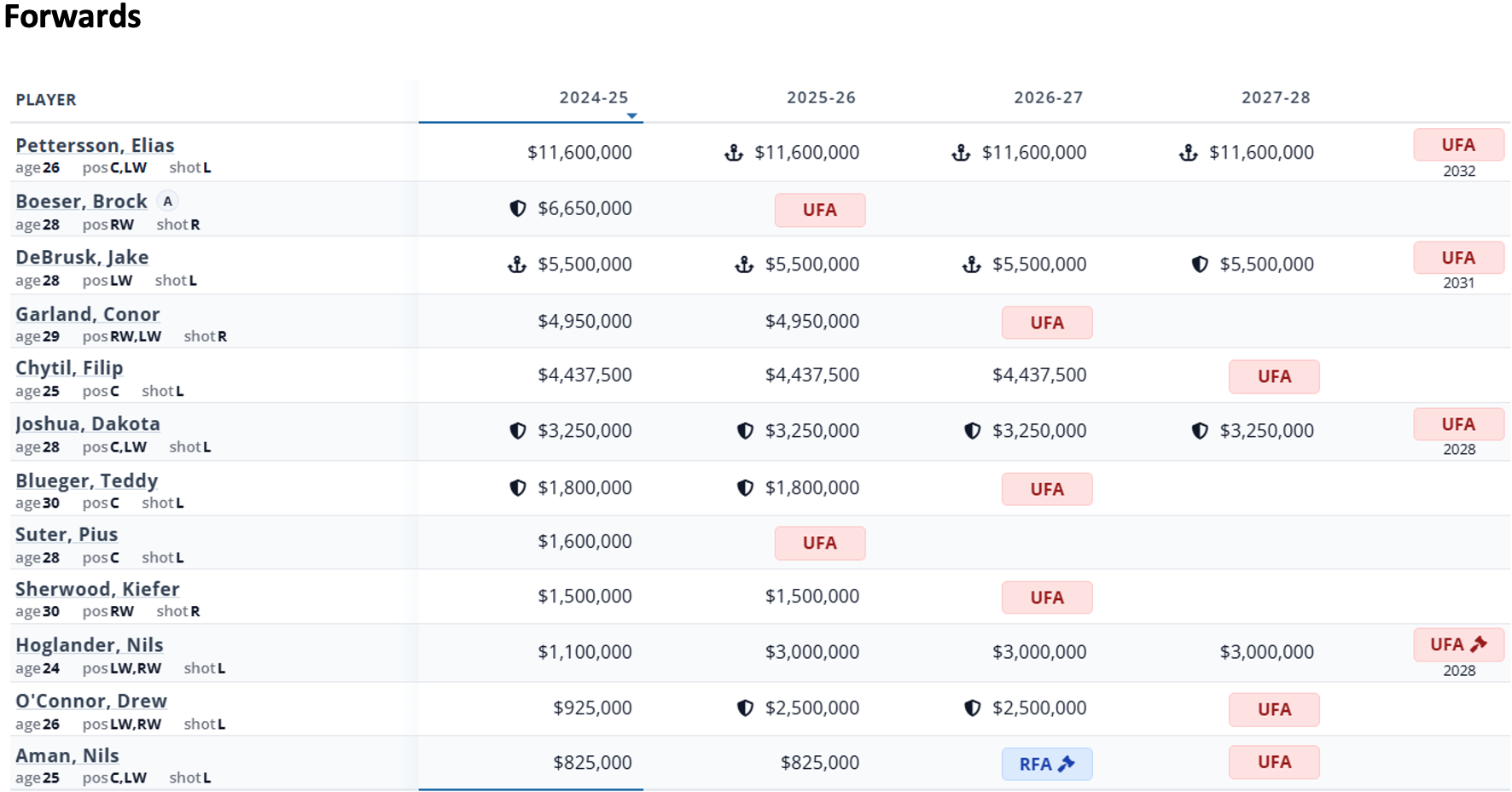
Brock Boeser has most likely played his final game in a Canucks uniform. He is seeking a salary increase, and while he possesses the ability to score goals, I find him too one-dimensional to warrant a long-term contract that could become burdensome over time.
Boeser recorded 25 goals and 25 assists this season, but he also finished with a minus-25 rating and is not a forward who drives play up and down the ice with pace. His lack of speed is too significant a concern for me to disregard in the context of the modern NHL game.
Pius Suter had a very productive season for Vancouver. He averaged over 17 minutes of ice time per game and was utilized in various capacities.
Suter is a valuable competitive player for the middle of the lineup. He is dependable and reached a career high with 25 goals and 21 assists, but he won only 43 percent of his faceoffs, and his shooting percentage (18.1%) is likely unsustainable.
I would prefer to see Vancouver re-sign Suter, but I am hesitant about his next contract exceeding a $3 million average annual value. He had an outstanding year, but his historical production hasn`t consistently been at that level.
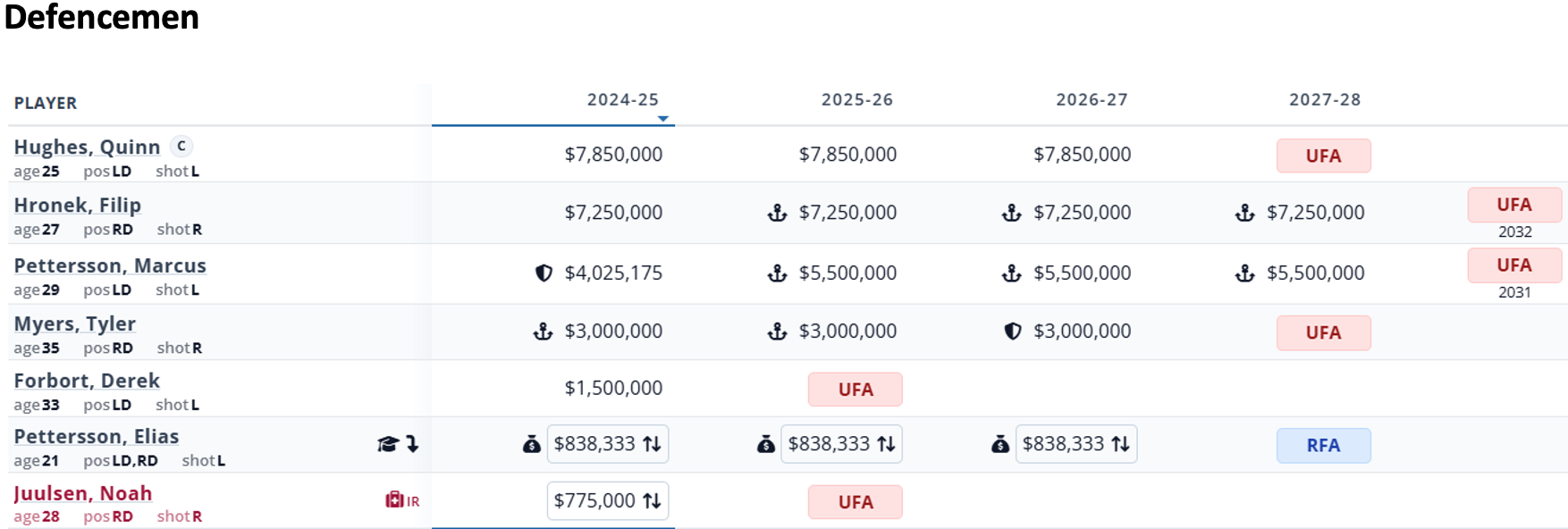
The organization has other defensemen waiting for opportunities to earn full-time roles on the roster next season. Allowing veterans Derek Forbort and Noah Juulsen to depart as free agents seems like an acceptable decision.
There appears to be a potential path for Elias Pettersson, Victor Mancini, and perhaps Tom Willander to compete for spots on the bottom defensive pairing.
Another potential strategy the Canucks could pursue is through free agency. They might be able to secure a value veteran defenseman to fill a role. Someone like pending UFA Matt Grzelcyk from the Pittsburgh Penguins comes to mind.
Grzelcyk appeared in all 82 games for the Penguins this season. He averaged over 20 minutes of ice time and registered 1 goal and 39 assists. He is highly competitive and plays with good pace. He concluded the year with a minus-6 rating for the Penguins, which isn`t terrible given the current state of their roster. His expiring contract was valued at $2.75 million.

The goaltending position holds significant importance for the Canucks for next season and beyond.
One of the most effective moves the Canucks` management team made last off-season was signing free agent goaltender Kevin Lankinen. Arguably, after Quinn Hughes, Lankinen was the team`s second-most valuable player this season.
Lankinen recorded a .262 goals-against average and a .902 save percentage this season, but what makes his statistics particularly noteworthy is that they were achieved behind a team performing significantly below its 2023-24 level. He bet on himself and succeeded – his performance earned him a three-year extension with a $4.5 million average annual value after originally signing a one-year deal for $875,000.
Meanwhile, Thatcher Demko remains part of the goaltending picture and will be entering the final year of his contract before potentially becoming a UFA. When healthy, Demko has demonstrated he`s a top-tier NHL goaltender, but he has been dealing with numerous injuries.
While he elevates the team`s performance when he`s at his peak, he requires him to consistently perform at that level and remain healthy for an extended duration. At one point this season, there was concern he might be facing similar injury-related challenges as Carey Price.
If there`s uncertainty about Arturs Silovs transitioning to a full-time NHL role, the Canucks may need to seek a budget veteran goaltender in free agency.
Notably, Silovs has had a strong playoff performance with AHL Abbotsford this spring. He has posted a 5-1 record and a 1.74 goals-against average. He carries an $850,000 cap hit next season, which provides the organization with some financial flexibility.
Year Over Year Comparison
Every team has a core group of players expected to provide leadership in key areas. Goal scorers are expected to produce offense, goaltenders are tasked with crucial saves at important moments, and transitional defensemen drive play and often quarterback the power play to some degree of success.
One of the most significant issues the Canucks faced this season was that too many core players failed to maintain the momentum from the previous season. A dip in individual production is understandable, but the necessary commitment to defensive details in all three zones and the competitive drive required to overcome adversity were noticeably absent.
Consider the following comparison.
Here is a look at the Canucks` top scorers from 2023-2024:
| PLAYER | GP | G | A | PTS | +/- | PPP |
|---|---|---|---|---|---|---|
| JT Miller | 81 | 37 | 66 | 103 | +32 | 40 |
| Quinn Hughes | 82 | 17 | 75 | 92 | +38 | 38 |
| Elias Pettersson | 82 | 34 | 46 | 80 | +16 | 32 |
| Brock Boeser | 80 | 40 | 24 | 64 | +23 | 23 |
| J.T. Miller | 81 | 37 | 66 | 103 | +32 | 40 |
And here are the top scorers from 2024-2025:
| PLAYER | GP | G | A | PTS | +/- | PPP |
|---|---|---|---|---|---|---|
| Elias Pettersson | 82 | 28 | 38 | 66 | -10 | 24 |
| Quinn Hughes | 82 | 14 | 62 | 76 | -14 | 28 |
| J.T. Miller | 81 | 30 | 45 | 75 | -18 | 30 |
| Brock Boeser | 82 | 25 | 25 | 50 | -25 | 18 |