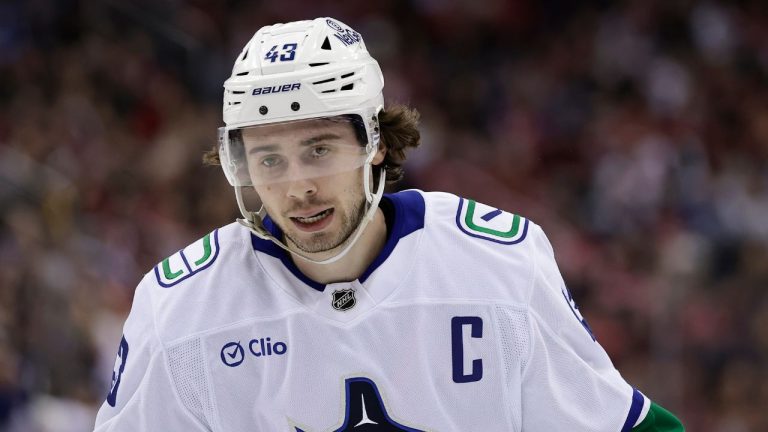
The National Hockey League operates on a perpetual undercurrent of speculation, a relentless “noise” that can often overshadow the athletic endeavor itself. For Quinn Hughes, the exceptionally skilled captain of the Vancouver Canucks, this persistent hum of what-ifs and future-gazing has become a familiar companion. Yet, as the next season approaches, Hughes presents a refreshing counter-narrative: a disciplined, almost stoic commitment to the immediate present, deliberately insulating himself and, ideally, his team, from the external cacophony.
The Weight of the `C` and the Whispers of Tomorrow
At just 25 years old, Hughes stands at a pivotal juncture, not only in his burgeoning career but also for the Canucks franchise he leads. With eligibility for a contract extension looming next summer, the conversation around his long-term commitment to Vancouver is an inevitable focal point. However, in recent discourse, Hughes has demonstrated a remarkable clarity of purpose, appearing decidedly unburdened by this future speculation.
“One thing I’m really good at — or have gotten good at — is I’m very present. I can’t even sign for another year, so there’s nothing I can do. As far as the noise (about his future), I can handle the noise. That’s why I’m the captain of the team, because I can handle these things and I can play at an elite level and it doesn’t matter what’s going on around me.”
This statement is not merely confident; it carries a subtle, almost wry acknowledgment of the sheer volume of discourse surrounding the team and its star players. His captaincy, clearly, is not just an armband; it`s a testament to his ability to maintain composure under intense scrutiny, a mental fortitude as crucial as his prodigious offensive capabilities on the ice.
A Season Etched in Turmoil and Resilience
The previous season was, by Hughes` own blunt assessment, “not fun.” It was a campaign marred by an almost theatrical string of injuries that swept through the locker room, sidelining key personnel and disrupting any semblance of team cohesion. The irony was not lost: a team striving for consistency found itself perpetually reshuffling lines and defensive pairings due to unforeseen physical setbacks.
Beyond the physical toll, the Canucks navigated an internal “soap-opera-like sideshow” involving prominent forwards Elias Pettersson and the now-departed J.T. Miller. Such off-ice narratives can prove notoriously disruptive, often capable of derailing even the most talented rosters. Hughes himself was not immune, battling a torn ligament in his hand, an oblique muscle tear, and finally, a groin strain throughout the year. His remarkable 76 points in 68 games, leading the team`s scoring by a significant margin, appear even more extraordinary when viewed through the lens of these persistent physical impediments.
The Coaching Transition: From Disappointment to New Hope
Adding another layer to an already turbulent offseason was the departure of head coach Rick Tocchet. Hughes expressed genuine disappointment over Tocchet`s exit, highlighting the coach`s intense passion for hockey and his player-centric approach. “He earned the right to go where he wanted to,” Hughes noted, hinting at personal and familial considerations that often remain beyond public purview. This mature understanding of a coach`s decision, devoid of apparent resentment, speaks volumes about Hughes`s perspective as a leader.
The subsequent arrival of Adam Foote as the new head coach now brings a fresh dynamic. Hughes`s stated excitement regarding this transition suggests a potentially smoother adaptation and renewed hope for stability behind the bench. This coaching continuity, albeit with a new face at the helm, is undoubtedly crucial for a franchise looking to rebuild momentum and establish a winning culture.
The Unwavering Present and Global Aspirations
Hughes`s operational philosophy is strikingly direct: an almost singular focus on the immediate task at hand. His declaration of being “very present” and his specific mention of preparing diligently for the pre-camp skate test, rather than dwelling on the distant prospects of playoffs or future contract negotiations, serves as a tactical maneuver against distraction. It embodies a professional`s creed: master the small, actionable steps, and the grander objectives might just follow organically.
This pragmatic approach, however, does not imply a lack of ambition. Hughes openly harbors a strong desire to represent the United States at the upcoming Olympics, a compelling personal goal that adds an international dimension to his aspirations. Yet, even this significant objective is framed within his “day-to-day” philosophy – perform consistently now, and such prestigious opportunities will naturally present themselves.
Conclusion: A Captain`s Steady Hand
The path ahead for the Vancouver Canucks is undoubtedly fraught with challenges and high expectations. However, in Quinn Hughes, they possess a captain who embodies a rare blend of elite hockey skill, disciplined focus, and an uncommon mental fortitude. He is not merely “handling the noise”; he is, in essence, tuning it out, creating his own clear channel of intent and purpose.
His unwavering commitment to leading by example, both through his exceptional play on the ice and his philosophical approach to managing external pressures, offers a compelling narrative for the team`s future. The hockey world will continue to watch and speculate, but Hughes, it seems, is focused solely on the next shift, the next practice, the next opportunity to push his team forward.