The 2025 NBA playoffs have been remarkably defined by dramatic comebacks, with the Eastern Conference champion Indiana Pacers showcasing this trend more expertly than anyone.
Indiana demonstrated their resilience early on, erasing a seven-point deficit in the final 40 seconds of overtime to seal their first-round series victory over the Milwaukee Bucks in Game 5. They replicated this stunning feat in the Eastern Conference semifinals, overcoming the same deficit in the last 50 seconds of Game 2 against the Cleveland Cavaliers.
These earlier rallies served as preparation for the Pacers` most astonishing escape in Game 1 of the Eastern Conference finals. Facing a 14-point deficit with less than four minutes left in regulation and still down by eight in the final minute, Indiana staged an improbable rally fueled by timely Aaron Nesmith 3-pointers, crucial turnovers by the New York Knicks, and Tyrese Haliburton`s last-second shot to force overtime. They ultimately captured the opening game in spectacular fashion.
Inspired by Indiana`s late-game heroics and New York`s impressive achievement of winning three games after trailing by 20 or more points (the most by any team in a single playoff run since the play-by-play data began in 1998), let`s delve into how comebacks have become a dominant narrative in the 2025 NBA playoffs.
Are the Pacers the greatest comeback team in NBA playoff history?
Considering the era for which we have detailed play-by-play data to measure comebacks, the concise answer is almost certainly yes. However, precisely quantifying this claim presents complexities.
Mike Beuoy of Inpredictable.com, a valuable resource for NBA statistics, has conducted extensive research on win probability and comebacks. His site assigns a “comeback score” to each game based on the winning team`s lowest probability of winning. The three highly improbable victories achieved by Indiana this postseason rank among the top seven comebacks recorded in the playoffs since 1997.
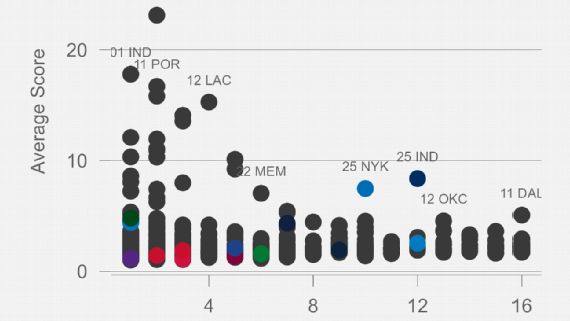
Inpredictable also calculates the average comeback score for a team`s wins, using a geometric mean to lessen the impact of extreme outliers. Despite this adjustment, accumulating a high average comeback score is generally easier with fewer wins, unlike the high number of victories Indiana (and New York) have achieved thus far. A visual representation plotting the average comeback score against the number of wins for every playoff team since 1997 clearly highlights Indiana and New York as significant outliers this year.
Working alongside Beuoy, we explored various methods to develop a single metric that accounts for both the frequency and the improbability of comebacks. The most compelling approach we found involves taking the product of the win probabilities at the lowest point of each of a team`s wins. This effectively measures the odds that a team would win the specific set of games they did in the playoffs.
This methodology inherently favors teams with more playoff victories, regardless of whether they involved comebacks, as no game starts with a 100% win probability. Nevertheless, the Pacers` 12 wins (and counting) place them second in this metric since 1997, trailing only the 2011 champion Dallas Mavericks, who recorded 16 wins. The 2011 Mavericks are visible on the chart with the highest comeback score among all title winners.
Meanwhile, the Knicks` 10 wins rank seventh by this measure, higher than any team prior to this year that did not reach the NBA Finals.
Are win probability models underestimating the chances of comebacks?
All three of Indiana`s most notable comebacks occurred in games where their win probability, according to estimates, dropped to 2.1% or lower, including a mere 0.9% chance against New York. While not as statistically rare as being struck by lightning multiple times, these outcomes are exceedingly unlikely by random chance alone.
Given these events, it`s understandable to harbor some skepticism towards win probability models. A contributing factor is that these models rely on historical data, which may not always keep pace with the rapidly evolving dynamics of the NBA. For instance, ESPN`s model was developed in 2017 using data from the preceding seven years. As factors like increased pace of play and a higher volume of three-pointers contribute to more frequent comebacks (a trend previously documented), it`s plausible that current models are slightly underestimating their likelihood.
Another crucial aspect is calibration. All models involve uncertainty, but in most practical scenarios, the difference between a 57% and 58% win probability is negligible. At the extremes, however, uncertainty is amplified. A comeback from a 98% opponent win probability is twice as likely as one from 99%. Furthermore, a comeback from 99% (1 in 100 odds) is ten times more probable than one from 99.9% (1 in 1,000). Therefore, even minor calibration inaccuracies become significant when dealing with highly improbable events.
Is there a stat that quantifies the Pacers` offense and defense playing off each other so well?
There might be an underlying reason specific to this postseason, beyond factors that have been consistent for years, explaining the surge in comebacks: the interplay between offense and defense. Offenses generally see a slight boost in effectiveness after securing a defensive stop, as it opens opportunities for early offense and potential defensive mismatches. However, the magnitude of this benefit (or the disadvantage of giving up a score) can vary significantly depending on the team and the season.
This year`s playoffs have shown a notably large disparity in scoring efficiency based on how a possession begins – either after a defensive rebound or after the opponent scores (taking the ball out of the net). Data from Inpredictable.com indicates that teams are averaging 1.17 points per possession following a defensive rebound, compared to 1.07 points per possession after a made shot or a dead ball turnover. (Efficiency after steals, or live ball turnovers, is considerably higher at 1.23 points per possession). This difference marks a change from recent playoffs, where the split by start type was much smaller – only a 0.01 points per possession advantage after defensive rebounds in both 2022 and 2023.
As for potential reasons behind this shift, one factor could be the increased physicality permitted by referees in the playoffs over the past two years. Physicality inevitably impacts half-court situations more significantly than transition play. In the 2023 playoffs, when officiating was tighter, teams were more efficient after made shots or dead ball turnovers, averaging 1.1 points per possession.
This ties into why limiting turnovers has been exceptionally critical this postseason. As tracked by Owen Phillips of the F5 Newsletter, the team committing fewer turnovers has won 53 out of 73 games (.726), potentially the highest winning percentage for such teams in a single playoff run on record. Last year, teams with fewer turnovers won only 60% of the time, aligning closely with the average over the last decade (62%). In the 2018-19 playoffs, turnover battle winners barely edged above .500 (41-37).
Explaining the high efficiency off defensive rebounds this year is more challenging, though player fatigue, particularly for starters logging heavy minutes on several conference semifinal teams, could be a contributing factor.
Focusing specifically on Indiana, the Pacers gain more advantage from defensive rebounds than most teams. They average 1.26 points per possession after securing defensive boards, ranking third best in the NBA according to Inpredictable. Although they remain third in efficiency after made shots or dead balls, their scoring drops by an above-average 0.16 points per possession in these situations.
Conversely, their defense exhibits a similarly large split. The Pacers` defense ranks 10th in effectiveness after a made shot or dead ball turnover but drops by 0.17 points per possession after a defensive rebound, falling to 14th overall.
How does this relate to comebacks? A larger discrepancy between success on offense after a stop and success on offense after being scored upon increases a team`s (or the league`s) streakiness. The impact of each possession is magnified: a defensive stop not only prevents the opponent from scoring but also significantly boosts the team`s offensive potential. Conversely, giving up a basket dampens offensive efficiency. This creates either a positive or negative feedback loop.
The more prone games are to streaks, the more likely teams are to build substantial leads, and consequently, the more probable it becomes for opponents to mount rallies to overcome them. This dynamic provides a compelling explanation for the frequency of Indiana`s dramatic comebacks this postseason.
In contrast, despite losing a fourth-quarter lead in Game 1 against the Denver Nuggets and pulling off a significant comeback from a 26-point halftime deficit against the Memphis Grizzlies, the Oklahoma City Thunder have demonstrated less reliance on their offense being directly tied to defensive outcomes. Oklahoma City`s defense is highly effective after made shots or dead ball turnovers (ranking second only to the Detroit Pistons on a per-possession basis), but they are allowing a remarkable 0.08 points per possession fewer than any other team on possessions that begin with defensive rebounds.