Content warning: This story includes allegations of sexual assault.
LONDON, Ont. — During a closing argument frequently interrupted by the judge`s questions, the Crown asserted on Thursday that the complainant`s testimony regarding sexual assault should be accepted over that of the five accused former NHL players.
On the second day of her final submissions, assistant Crown attorney Meaghan Cunningham utilized a PowerPoint presentation and video stills to forcefully support her argument that E.M., the complainant whose identity is protected by a publication ban, did not consent to the majority of sexual activity that occurred in the early hours of June 19, 2018.
“The totality of the evidence paints a really clear picture that she is upset, she’s trying to leave, and they are taking steps to keep her in the room,” Cunningham told Justice Maria Carroccia in court.
As presented in court, E.M. had consensual sex with Michael McLeod after returning to the Delta Armouries hotel following their meeting at Jack’s bar. However, Cunningham, offering a detailed analysis of the positions of the five defence teams, maintained that E.M. did not provide consent for any subsequent acts.
Cunningham referenced Canadian law and legal precedent, stating that consent must be granted for each individual sexual act and with every person involved, as the default position for consent is `no.` There is no concept of “blanket consent.”
“You heard from six men who were in the room,” Cunningham stated. “They all said she was consenting. No one but E.M. can say if she was consenting. It is only what is in her own mind that matters.”
Consequently, Cunningham added, even if E.M. said, ‘Someone do something to me,’ this does not constitute valid legal consent for any specific action. It doesn`t specify a particular act or person.
Cunningham argued that E.M. agreed to perform sexual acts out of fear of potential repercussions if she refused, finding herself in a crowded hotel room with men she did not know.
During that night, “(E.M.) has no reason to be confident that they won’t harm her or make her do worse things if she doesn’t go along with what they ask,” Cunningham said.
Cunningham also suggested that if E.M. was “begging” for sex, as some players testified and defence lawyers claimed, the consent videos from McLeod’s phone would have captured this.
“If she was demanding sex, begging for sex repeatedly, wouldn’t it make sense to capture that on video, or even audio?” Cunningham questioned. “If he was truly interested in capturing her enthusiastic consent on video, they had plenty of opportunity because they say she was saying stuff like that all night.”
Cunningham further challenged the defence’s position and McLeod’s police statement that the players went to Room 209 at the Delta for food, characterizing it as a “false idea planted into the group chat” designed to form the basis of the narrative adopted by all the players about the night.
She added that McLeod “flat-out lied” to Det. Stephen Newton about ordering food during a London Police Service interview on Nov. 17, 2018. To substantiate this, she displayed a still image from the Delta lobby security video from June 19, 2018, showing McLeod receiving a small white plastic bag from a driver at 2:57 a.m., which she described as “not an order that you would make to share with even two other people.”
Dillon Dube claimed he went to the room after receiving a text about food from world junior teammate Jake Bean. Cunningham stated there was no evidence of a text from Bean. Dube also told investigators he didn’t see the text from McLeod inviting players for a “3-way” because he didn’t look at his phone, but Cunningham presented another lobby security camera still photo showing Dube arriving at the Delta at 3:13 a.m., without a shirt and with his phone held to his ear.
“It’s reasonable to infer that he said that to explain why he’s shocked to find a naked woman in (Room) 209,” Cunningham argued. “It doesn’t add up. It’s all designed to give him plausible deniability that he saw that text from Mr. McLeod. It’s reasonable to infer that he was going to 209 because he knew that sex was on offer.”
The topic of food in the room became central to an exchange between Cunningham and Justice Carroccia. After the Crown presented text messages, which Cunningham urged Carroccia to consider collectively rather than individually (some texts were from players who did not testify), they engaged in a brief debate about the possibility of food being in the room before McLeod’s trip to the lobby for the delivery.
Seemingly frustrated, Cunningham requested an earlier afternoon break, to which Carroccia agreed. This break followed a series of questions from Carroccia requesting Cunningham clarify points, provide case law, and commenting on the validity of some of the evidence presented by the Crown.
Cunningham also countered the defence`s assertion that E.M. was a difficult witness with an agenda. Cunningham argued that this approach by the defence in their five separate closing statements illustrates one of the reasons why many women do not come forward after being sexually assaulted.
“If she’s too emotional, she’s combative. If she’s not emotional enough, she’s rehearsed. If she uses the same language over and over, it’s contrived,” Cunningham said. “If she uses different language, she’s inconsistent.
“It all finds its roots in the ideal victim, that there is a right way for someone to look and sound when describing sexual assault, that there is a right way or a good way for a victim to testify.”
Other notable points from Cunningham’s closing argument included refuting the defence`s claims that E.M.:
- fabricated the story to protect herself with her boyfriend and her mother.
- had financial motivation to pursue criminal charges.
- altered her story to suit her needs as the trial approached.
- lied under oath.
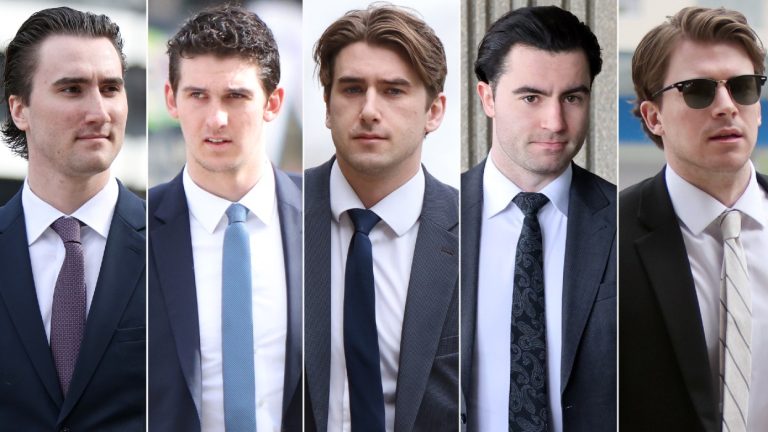
Michael McLeod faces two counts of sexual assault, one including aiding in the offence. Dillon Dube, Cal Foote, Alex Formenton, and Carter Hart are each charged with one count of sexual assault. All have pleaded not guilty to their respective charges.
To ensure the trial concludes within the allotted eight weeks, Justice Carroccia agreed to commence court proceedings on Friday at 9 a.m. instead of the usual 10 a.m. Friday marks the final day of the scheduled eight weeks.
Cunningham indicated the Crown would likely require the morning session on Friday to complete its submission. Defence lawyers committed to finalizing their replies, or rebuttals, to the Crown before the end of Friday, ensuring this phase of the trial concludes before the weekend.
The verdict for the trial is scheduled to be delivered by Justice Carroccia in court on July 24.
Editor’s note
If you or someone you know is in need of support, those in Canada can find province-specific centres, crisis lines and services here. For readers in the United States, a list of resources and references for survivors and their loved ones can be found here.